 Quote Cart
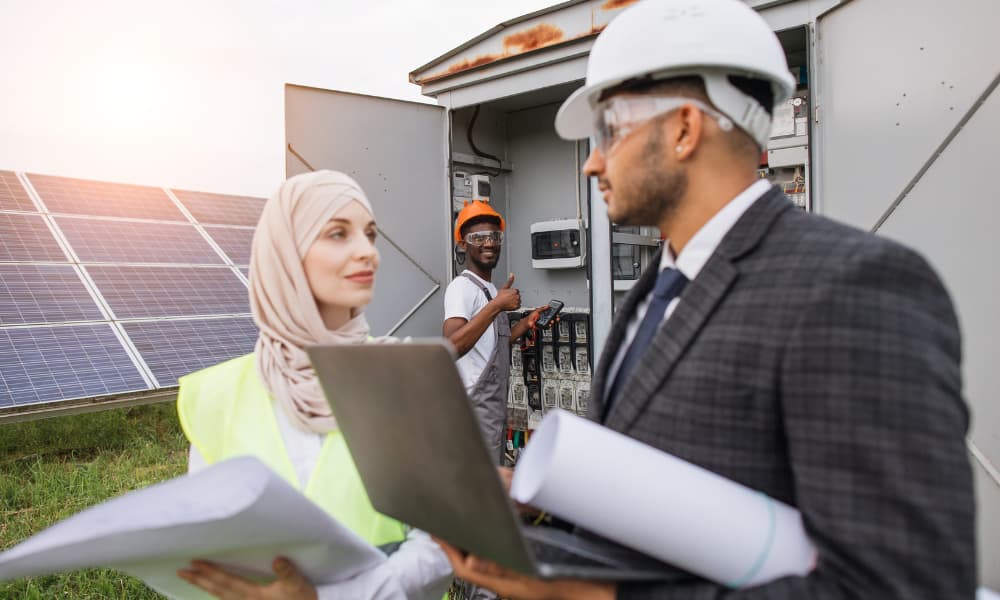
Avoid security gaps and network downtime in commercial buildings with solar plus storage that supports continuous uptime and business continuity.
Key takeaways
- Power instability can disrupt security, networking, and communications even without a full blackout.
- Solar plus storage improves uptime by keeping critical systems operational during outages.
- Security cameras, access control, and network infrastructure are highly vulnerable to power fluctuations.
- A layered resilience approach combines UPS, storage, and microgrid controls for better continuity.
- Treating energy systems as part of infrastructure planning strengthens overall business resilience.
Power disruptions in commercial buildings rarely occur as complete outages that shut everything down at once. More often, they appear as brownouts, voltage fluctuations, or brief instability that affects systems without immediately triggering alarms.
These conditions are easy to overlook, but they directly impact sensitive infrastructure. Security cameras can drop offline, access control systems may fail to respond correctly, and network performance can degrade in ways that reduce operational visibility.
Traditional backup strategies often focus on full outages, leaving these smaller but frequent disruptions unaddressed. As a result, critical systems remain exposed even when power appears to be available.
At the same time, solar adoption is accelerating, with capacity growing at an average of 28% annually over the past decade, according to the Center for Sustainable Systems. However, generation alone does not address instability during outages or grid disturbances.
That is why solar plus storage should be treated as part of a broader infrastructure resilience strategy. When designed correctly, it helps maintain uptime, reduce risk, and support business continuity across security, networking, and communications systems. Dive in for more.
Why should commercial buildings use solar plus storage for security and network uptime?
Commercial buildings should use solar plus storage because it supports continuous uptime for essential systems during power disruptions. Unlike solar alone, a properly designed solar-and-storage solution can help maintain security, networking, and communications infrastructure, improving resilience, reducing operational risk, and supporting business continuity.
Why solar plus storage is becoming a business continuity strategy
Many organizations still approach solar as a way to reduce utility costs, while gaps in security and IT resilience remain underplanned. That separation is becoming harder to maintain as power instability becomes more frequent. Energy strategy now directly affects operational risk.
Solar plus storage supports business continuity, not just sustainability. It helps keep critical systems running when the grid becomes unreliable and ensures that power disruptions do not immediately translate into operational downtime. For this reason, it belongs in the same planning conversation as cybersecurity, physical security, and network resilience.
The priority is not simply generating power but maintaining control of essential systems during outages and grid disturbances. When designed correctly, solar-backed storage keeps security, networking, and communications infrastructure online, reduces disruption, and preserves visibility across operations. That is what makes it a practical and increasingly necessary resilience strategy.
Which critical building systems are most vulnerable during power disruptions
Even short power disturbances can affect multiple systems at once, revealing how interconnected commercial building infrastructure has become.
The following systems are especially vulnerable when power becomes unstable:
1. Security cameras and video surveillance
Camera systems can go offline within seconds of a disruption, creating immediate gaps in visibility. This limits the ability to detect, verify, and respond to incidents in real time.
2. Access control and entry management
Power instability can disrupt badge readers, locks, and control panels, increasing exposure at entry points. At the same time, systems must continue to meet life safety requirements to ensure safe egress.
3. Network infrastructure and PoE environments
Switches, uplinks, and intermediate distribution frame/main distribution frame (IDF/MDF) closets support nearly every connected system in the building, yet they rely on consistent power. Without proper backup, power over ethernet (PoE) devices such as cameras and access points can drop offline quickly.
4. Communications and business coordination
Voice over Internet protocol (VoIP) systems, wireless networks, and intercoms are essential for coordination during disruptions. When these systems fail, teams lose the ability to communicate internally and externally at critical moments.
While these systems may not require large amounts of power, they are essential to maintaining security, connectivity, and operational control.
How solar-backed storage supports security, networking, and communications during an outage
When an outage occurs, reliable power becomes essential. Security, networking, and communications systems depend on continuous uptime to maintain visibility, control, and coordination across operations.
Solar-only systems typically cannot support a building during an outage. Without storage and the appropriate controls, they shut down along with the grid, leaving critical systems without power.
Solar-backed storage addresses this gap by keeping prioritized systems online. It supplies power to essential loads, ensuring that core infrastructure continues operating even when utility power is lost.
A layered resilience approach helps deliver power seamlessly and for the required duration:
- UPS systems provide immediate ride-through power in seconds or milliseconds, preventing system reboots and interruptions
- Battery storage extends runtime, supporting continued operation during longer outages
- Microgrid controls manage load prioritization and enable islanding, allowing the building to operate independently from the grid
With this approach, power is directed where it matters most, keeping security, networking, and communications systems operational throughout disruptions.
Why Power Prioritization Matters More Than Trying to Back Up Everything
Trying to back up an entire building often increases costs without improving resilience. A more effective approach focuses on the systems that directly support operational continuity.
A stronger power prioritization strategy is built around the following considerations:
- Defining the critical load spine: This starts with identifying and isolating the systems that must remain online, including security head-end equipment, core networking hardware, telecommunications infrastructure, and selected PoE closets. These components form the foundation of operational continuity during an outage.
- Matching runtime expectations to operational needs: Not all systems require the same level of backup support. Some require uninterrupted power, others can tolerate brief restarts, and some only need extended runtime to maintain continuity or enable safe shutdown. Grouping systems accordingly allows for more precise and efficient planning.
- Protecting power quality, not just power availability: Power instability can affect sensitive systems even when the grid remains active. Voltage fluctuations and inconsistent supply can lead to performance issues or system failure. Maintaining stable, clean power is therefore as important as ensuring backup availability.
A focused prioritization strategy ensures that critical systems remain protected without overextending resources across the entire building. It provides greater control over uptime, reduces risk, and strengthens overall operational continuity.
Where solar microgrids make the most sense
Not every facility requires the same level of energy resilience. The value of a solar microgrid for commercial campuses depends on how critical operations are and how much disruption systems can tolerate.
Solar microgrids deliver the most operational value in the following environments:
- Single commercial buildings: These sites benefit when critical systems are concentrated and electrical loads can be clearly segmented. This makes it easier to isolate essential infrastructure such as security, networking, and communications for reliable backup support.
- Commercial campuses and multi-building environments: In larger campuses, resilience is most effective when it is coordinated across multiple buildings and shared infrastructure. Solar microgrids enable distributed energy resources to support the entire environment in a more consistent and controlled way.
- Critical facilities with higher-consequence downtime: This includes healthcare facilities, public safety operations, data centers, transportation hubs, and industrial sites. In these environments, even short disruptions can create significant operational, financial, or safety risks.
Solar microgrids are especially valuable where downtime has immediate consequences. They provide scalable resilience that adapts to complex environments and supports long-term operational stability.
Planning considerations before a solar plus storage project moves forward
Solar plus storage projects require coordination across facilities, IT, and security teams to ensure the design aligns with real operational needs. The following considerations help guide a more effective planning process:
What must stay online and for how long
Facilities, IT, security, and risk teams need to align on which systems are critical and how long they must remain operational during an outage. This defines the foundation for all resilience planning decisions.
How the building is wired and distributed
Understanding whether systems are centralized or distributed across multiple closets helps determine how backup power should be designed. Existing electrical layouts and current backup infrastructure also influence how storage can be integrated.
Communications redundancy and external connectivity
Power continuity alone is not sufficient if telecom or internet backhaul fails during a disruption. Redundant communication pathways are necessary to maintain coordination and external connectivity.
Safety, compliance, and operational readiness
Projects must account for interconnection standards, battery safety requirements, permitting, testing, and ongoing operational procedures. These factors ensure the system is both compliant and reliable over the long term.
Successful deployment of solar plus storage for commercial buildings depends on early alignment between technical requirements and operational priorities. A consultative approach ensures the system is designed to support real-world resilience, not just theoretical performance.
The business case for treating solar plus storage as integrated infrastructure
When resilience is evaluated from an operational perspective, the value of solar plus storage is directly tied to uptime, risk reduction, and continuity performance.
The business benefits become clear when solar plus storage is treated as part of integrated infrastructure:
- Reduced downtime and fewer security gaps
- Stronger protection for critical operations and site access
- More predictable continuity planning during outages and grid instability
- Better alignment between facilities, IT, security, and executive risk priorities
- Greater long-term value when resilience planning is built into broader technology initiatives
Together, these outcomes reinforce why solar plus storage should be viewed as a core infrastructure investment rather than a standalone energy upgrade.
